Business site
Business website vs social media: do you need both in 2026?
 By Benjamin11 min read
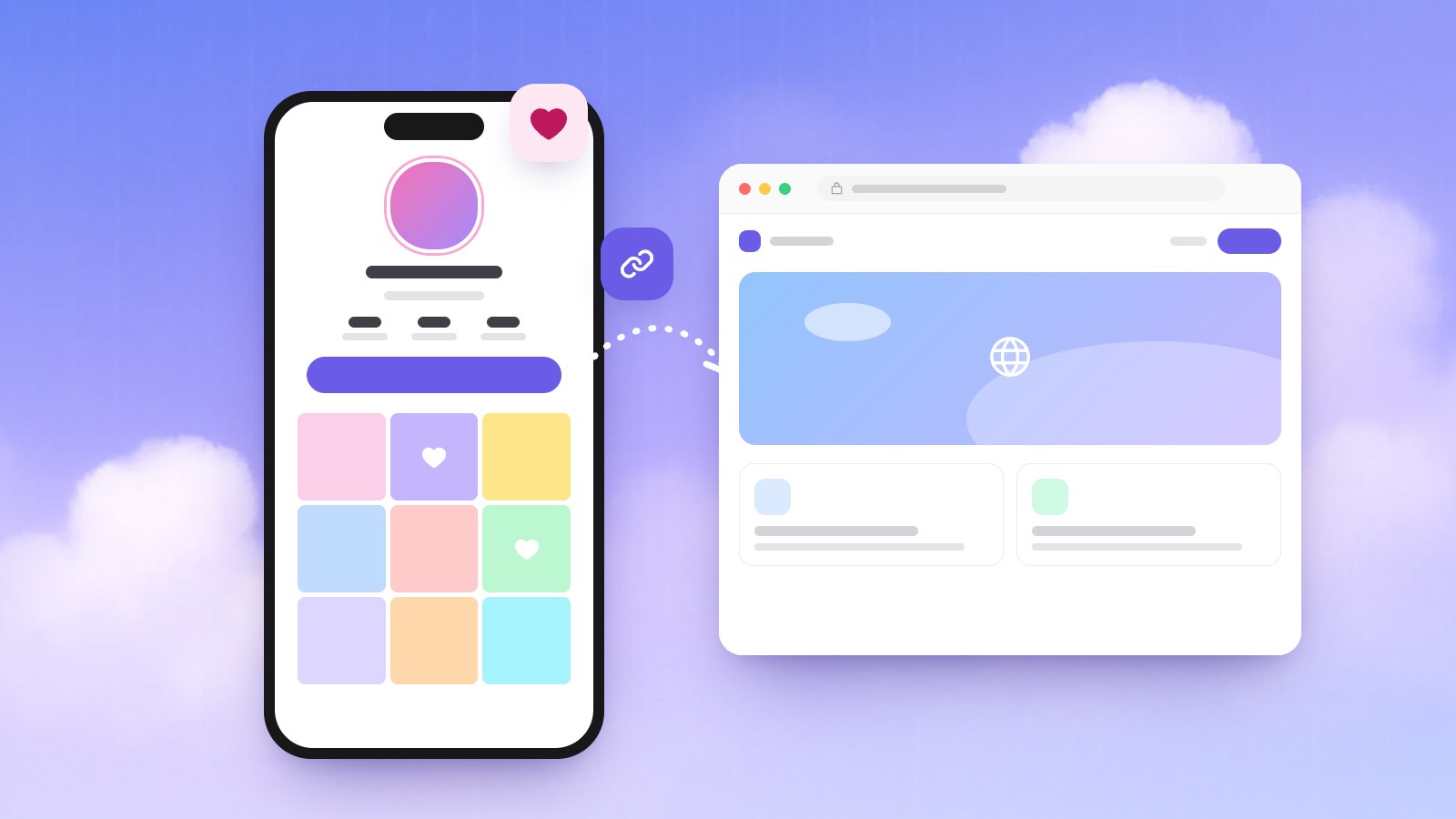
Most small businesses start online with a social media page, and it makes sense. An Instagram account or a Facebook page costs nothing, takes minutes to set up and puts you where your customers already scroll. DataReportal's Digital 2027 Global Overview Report counted 5.81 billion social media user identities in October 2026, equal to 69.9% of the world's population (identities, not always unique people).
So if the page is working, do you still need a website? This guide compares the two on ownership, reach, search, trust and turning visitors into customers.
In short: Yes, most businesses need both, because they do different jobs. Social media is best for being discovered and staying in touch. A website is the address you own: search engines and AI assistants can read it, it keeps your prices, menu and hours in one place, and its forms turn interest into inquiries. Keep posting, and send people to your site.
What social media does well
Social feeds don't only show posts from accounts people follow. Instagram's own explainer, Instagram Ranking Explained, says your feed mixes content from accounts you follow with recommended content from accounts it thinks you'll enjoy, plus ads. That is how a local bakery's video can reach thousands of strangers.
Social media is strong at:
- Discovery: short videos and shares put you in front of new people for free.
- Proof of life: regular posts show you're open, busy and real.
- Conversation: comments and direct messages make quick questions easy.
- Speed: a post about today's special or a free slot this afternoon goes out in seconds.
It matters most with younger customers. In GWI's global survey, reported in the same DataReportal report, social networks were the top destination for brand research among internet users aged 16 to 24, chosen by 46.9% of them. People aged 65 and over were more than 4 times more likely to research purchases on search engines than on social media.
No channel works alone, though. Search engines were the top way people discovered new brands, yet only 32.0% of online adults named them, just ahead of TV ads (30.6%) and social media ads (30.4%). The typical online adult uses 5.82 different channels to find new brands.
What a website does that a social page can't
A profile is a page inside someone else's product: the layout, the rules, the reach and the data belong to the platform. A website belongs to you.
| What matters | Social media page | Your own website |
|---|---|---|
| Who sets the rules | The platform, which can change them or close your account | You, within the law and your host's terms |
| Who sees your content | Whoever the feed's ranking picks | Anyone with the link, plus visitors from search |
| How long content stays useful | Posts slide down the feed as new ones arrive | A page keeps working until you change it |
| Search engines | Limited, pages behind a login may not be crawled | Built to be crawled and indexed |
| Information customers need | Scattered across posts, highlights and comments | Menu, prices, hours, services and FAQs in one place |
| Inquiries and bookings | Direct messages, answered one by one | Forms and booking requests that are stored and emailed |
| Your address | facebook.com/yourpage or @yourname | yourbusiness.com |
| Data | The platform's insights, on its terms | Your own visitor numbers and inquiries |
Established businesses already treat a website as the baseline. According to Eurostat's digital economy statistics for enterprises, 79.01% of EU enterprises with at least 10 employees had a website in 2025, while 63.57% used any kind of social media.
Who owns your social media page?
You own your brand, but not the account it lives on. Meta's Terms of Service say that if Meta determines, "in our discretion", that you have clearly, seriously or repeatedly breached its terms or policies, it may "suspend or permanently disable" your access and may permanently disable or delete your account. TikTok's Community Guidelines list a warning, a temporary feature or account restriction, or a full account ban as possible actions, and an account can be banned for repeated violations or a single severe one.
Moderation isn't perfect either. Instagram's ranking explainer says that if you think it made a mistake, "and we do make mistakes", you can appeal. While you wait, your page and followers are out of reach. A phishing message, a reused password or a former employee with admin rights can also lock you out, and getting back in depends on the platform's recovery process.
A website changes the balance:
- Your domain stays yours as long as you renew it, whatever happens to any platform.
- You can move. If your builder lets you export your website, you can take it elsewhere instead of starting over.
- You keep the contacts people send you. Every form submission is a customer you can reach again.
Protect your social accounts too: turn on two-factor authentication, give a second trusted person admin access and remove former staff the day they leave.
Organic reach: why your followers don't see every post
Followers aren't subscribers. Instagram explains that it weighs thousands of signals and predicts how likely each person is to interact with a post, and that "the more likely you are to take an action, and the more heavily we weigh that action, the higher up in Feed you'll see the post."
For a business, that means:
- Each post reaches only part of your followers, and that share changes from post to post.
- A useful post that gets few early reactions can quietly disappear.
- When reach drops, the platform's answer is usually a paid boost.
A website runs on a different clock. A page called "Wedding cakes in Leeds" doesn't have to win a feed: it stays at its address and can be found in search months after you publish it.
Can customers find you on Google and in AI answers?
Search engines are still where many people research a purchase. In GWI's survey for the second quarter of 2026, reported by DataReportal, 45.3% of online adults used search engines to research brands, ahead of social networks at 41.8%. Product and brand websites were picked by 32.9% and AI tools by 26.0%, and people combine an average of 3.8 of these channels.
Google finds pages by crawling the open web. Its in-depth guide to how Google Search works describes a fully automated search engine that uses crawlers to discover pages, and notes that some pages "may not be accessible without logging in". Much of what happens on social platforms sits behind a login or inside an app, which makes a profile a weak foundation for search.
AI assistants are now a discovery channel too. In BrightLocal's Local Consumer Review Survey 2026, a survey of 1,002 US adults, use of AI tools for local business recommendations jumped from 6% to 45% in a year, making them the third most popular source of recommendations. BrightLocal's advice: keep your website up to date, monitor your business listings for errors and check the sources AI tools reference.
Our AI website builder publishes every page with a title, a description and structured data, and the pages load fast and work on phones. Still, no one can honestly promise you a ranking: Google's guide says it doesn't accept payment to rank a site higher and doesn't guarantee it will crawl, index or serve any page. For the next steps, read our guides to getting your website on Google and to your Google Business Profile.
Trust: where customers check you out
People who find you on social media often look for more before they decide. BrightLocal asked consumers what they do after reading positive reviews: 54% go on to visit the business's website, up from 32% in 2019, while 37% read more reviews and 24% visit the business's social media channels. Without a website, you lose those people at the very moment they were deciding.
What are they checking? Nielsen Norman Group's research on trustworthiness in web design names four credibility factors: design quality, up-front disclosure, comprehensive and current content, and connection to the rest of the web. In its study, sites that left out basic information "were almost immediately ruled out" in favor of more open competitors. One participant rejected a cleaning company after 35 seconds because it didn't state its rates and wanted her to write in to ask.
That is the "DM for price" problem. A website with clear prices, opening hours, an address and real photos answers those questions even at 11 pm while you're asleep.
The same research cuts the other way: an isolated website that can't be found on review sites or social media looks like a business with something to hide, or one that isn't fully established. So link your profiles from your website and your website from your profiles. A custom domain helps too: yourbusiness.com and an email address on it carry your name everywhere.
Turning visitors into customers
Social media starts conversations. A website is better at finishing them, because it holds structured information and offers one clear next step.
| Business | What customers want to know | What the website gives them |
|---|---|---|
| Restaurant or café | Menu, prices, hours, location | A menu in real text, a map and a booking or contact form |
| Salon or barber | Services, prices, availability | A price list and a booking request form |
| Tradesperson | Areas served, past work, a quote | A gallery of jobs and a quote request form |
| Shop | Products, prices, how to pay | Product pages and payment links |
| Consultant or studio | Expertise, packages, references | Case studies, an about page and a contact form |
Eurostat's data shows what established businesses put on their sites: in 2025, the most common website feature was a description of goods or services with price lists, found on the sites of 66.36% of EU enterprises.
In our builder, contact forms and booking requests are saved in your site's database and emailed to you, so they don't get buried in a busy inbox of direct messages.
Analytics: see what actually works
Platform insights stop at the moment someone taps your link. Website visitor analytics pick up from there and show how many people reach your site and when. Note the date whenever you publish a post that links to your site, compare visits over the following days, and once a month check which posts came just before your busiest days.
How to make social media and your website work together
You don't have to choose. The strongest setup uses social media to reach people and the website to turn them into customers. If you don't have a site yet, start with our guide on how to create a business website.
1. Put your website in every profile
Add your site to the bio of every account. Instagram's help page on adding a website to your profile says you can add up to 5 websites, so you can link your homepage, menu and booking page separately.
2. Give every post a destination
Before you post, decide which page it should send people to: the menu, the offer, the booking form or the price list. "Link in bio" is far more useful when the link opens the exact page the post promised.
3. Keep your details identical everywhere
Your business name, address, phone number, opening hours and prices should match on your website, your social profiles and your Google Business Profile. Different hours on two channels confuse customers.
4. Recycle content in both directions
When a post gets lots of questions, it shows you a page your site is missing: a post answering "do you deliver?" can become an FAQ entry. Work the other way too. A new service page is a week of posts, and a free social media post generator can help you draft them.
5. Show your social proof on the site
Link your profiles and reviews from the website, and use the real photos you already post.
6. Protect the assets you own
Your domain, your website and your list of inquiries are the parts of your marketing no platform can switch off. Keep the domain on auto-renew, keep backups of the site and answer every form submission.
Frequently asked questions
Is a Facebook page enough for a small business?
A Facebook page is a good start, but on its own it leaves you dependent on one company's rules and feed. Meta's terms allow it to suspend or disable accounts, and your posts reach only the followers its ranking picks. A simple website next to the page gives you an address you own and a home for prices, hours and inquiries.
Can I use Instagram instead of a website?
Instagram is great for showing your work, but it isn't built to hold a full menu, a price list, a booking form or detailed service pages. Many customers also research on search engines, where a website is far easier to find than a profile. Use Instagram to attract people and your website to answer their questions and take their bookings.
Will a website get my business onto Google?
A website gives Google pages it can crawl and index, which a social profile often can't. Google doesn't guarantee it will index or rank any page, so nobody can honestly promise you a position, but clear page titles and useful content give you a fair chance.
What should my link in bio point to?
Point it at the page that matches what you post most: your menu, your booking page or your current offer. If the platform lets you add several links, as Instagram does with up to 5, link each important page separately.
How much does a business website cost?
It depends on how you build it, from free builders to custom agency work. See pricing for what you can build and publish for free and what Premium adds, such as your own domain and email on it. Our guide to what a website costs compares every option.
Sources
- Digital 2027 Global Overview Report, DataReportal, 2026.
- Digital economy and society statistics: enterprises, Eurostat, 2026.
- Meta Terms of Service, Meta, 2025.
- Community Guidelines: Accounts and Features, TikTok, 2026.
- Instagram Ranking Explained, Instagram, 2023.
- Add a website to your Instagram profile, Instagram Help Center, 2026.
- In-depth guide to how Google Search works, Google Search Central, 2025.
- Local Consumer Review Survey 2026, BrightLocal, 2026.
- Trustworthiness in Web Design: 4 Credibility Factors, Nielsen Norman Group, 2016.